

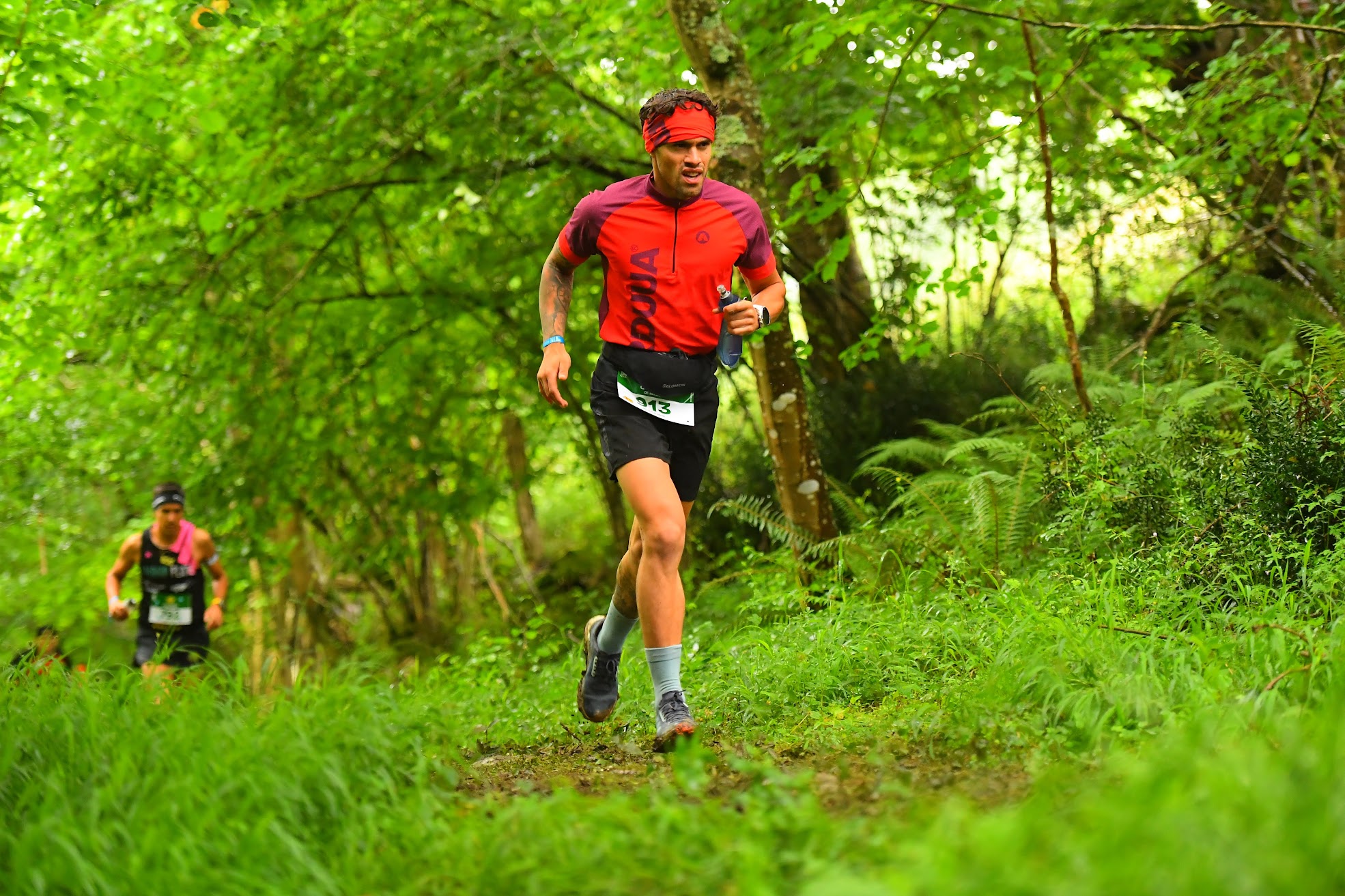
Running Technique – The BIG 5 (Fundamentals)
In this article, you’ll learn the BIG 5 fundamentals we use to assess running technique — what matters most, what commonly goes wrong, and how to start improving without overthinking your form.
This framework was originally presented in a webinar by Katinka Nyberg for beginner and intermediate runners. The goal was simple: to provide a clear, practical system for evaluating running technique — without chasing “perfect form” or focusing on elite-level details.
- – Injury risk
- – Running economy and efficiency
- – Long-term performance development
- – How running actually feels (light vs. heavy, smooth vs. forced)
Instead of emphasizing aesthetics or advanced biomechanical nuances, the BIG 5 highlights the foundational movement patterns that most strongly influence:
The webinar included interactive sessions and image analysis with real-world examples — including athletes from other sports such as hockey — to demonstrate how common running patterns appear in practice and how they can be coached in a clear and accessible way.
Based on participant feedback, this blog was created as a structured complement to the webinar, with clearer explanations and sharper distinctions between what’s RIGHT and what’s WRONG within each BIG category.
Why Technique Matters (and What “Good Technique” Really Improves)
Good technique isn’t about looking perfect. It’s about building a movement pattern that allows your body to handle load efficiently and sustainably.
When your technique improves, you typically gain:
- – Lower injury risk (better alignment and load distribution)
- – Better running economy (less energy cost at the same pace)
- – A stronger, more elastic stride
- – Higher tolerance to impact forces
- – Better coordination with less wasted movement
From a biomechanics perspective, two primary mechanisms explain why technique improves both performance and durability:
- – Better use of elastic energy — storing and releasing energy like a spring
- – Less braking — reducing deceleration forces, often caused by overstriding
Most technical errors reduce one — or both — of these.
Who This Is For
This guide is for you if you:
- – Are a beginner or intermediate runner
- – Feel your running is heavy, inefficient, or inconsistent
- – Want fewer injuries without obsessing over form
- – Have received conflicting advice about technique
The BIG 5 Framework
The BIG 5 is a practical checklist we use to assess running technique at a fundamental level:
- 1. Posture (Sagittal Plane)
- 2. Frontal Plane Alignment
- 3. Center of Mass & Step Placement
- 4. Foot Strike
- 5. Rhythm & Active Ground Contact
How to Use the BIG 5
You don’t need to fix everything at once.
Start with BIG 1 and work downward. Most runners improve dramatically by addressing posture, alignment, and step placement before worrying about finer details.
A key message from the webinar:
Everything is connected. Improving one BIG often improves the others.
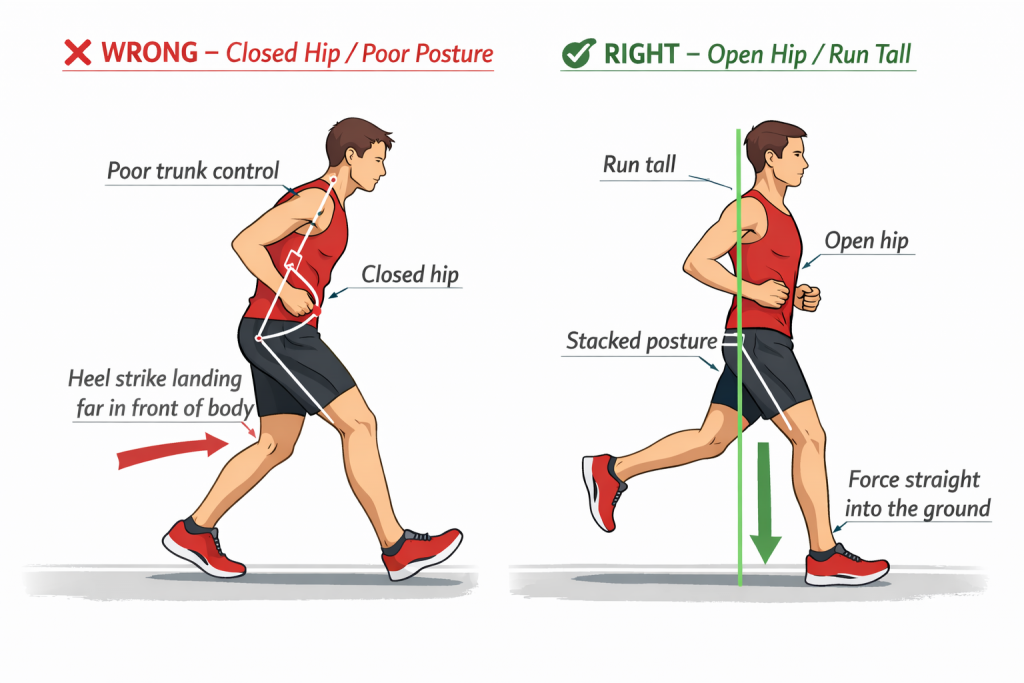
BIG 1/5 — Posture (Sagittal Plane)
Key cues: “Run tall” · “Zip up your core” · “Hips forward”
✅ What RIGHT Looks Like
- – Tall, stacked posture from head to pelvis
- – Open hips (not sitting back while running)
- – Neutral trunk (not excessively bent forward or arched)
- – Relaxed shoulders and neck
- – Arms swinging forward–back
When posture is correct, the runner looks:
- – Light
- – Stable
- – Ready to apply force efficiently into the ground
❌ What WRONG Looks Like
- – Closed hip posture (“sitting while running”)
- – Excessive forward bending from the waist
- – Poor trunk control (visible breaking or instability)
- – Tension in shoulders and arms
This often makes the runner look:
- – Heavy
- – Folded
- – Disconnected between upper and lower body
Why This Happens
Common in runners who:
- – Sit for long periods
- – Come from forward-leaning sports (e.g., hockey or cycling)
- – Have tight hip flexors or hamstrings
- – Lack posterior-chain strength
Fix Now
During easy runs:
- – Think “Run tall”
- – Lightly brace the core
- – Slightly increase cadence
- – Shorten the step
If posture improves when you shorten the step, that’s valuable feedback.
Work On (Long-Term)
- – Hip flexor and hip extension mobility
- – Hamstring mobility
- – Glute and hamstring strength
- – Upper-back and deep core control
Strong posture is developed, not forced.
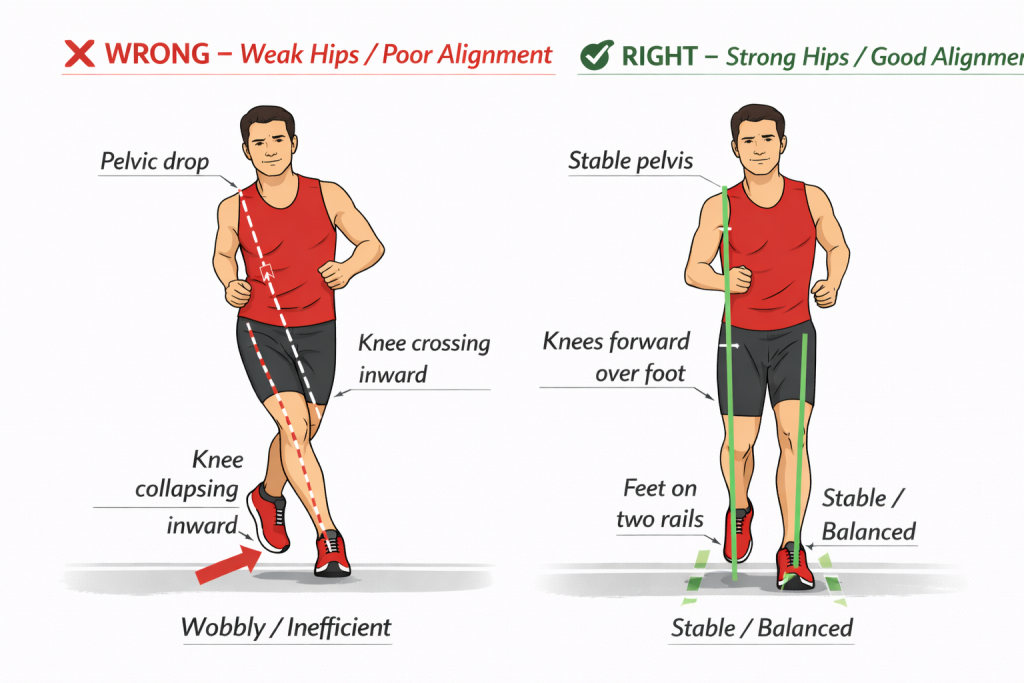
BIG 2/5 — Frontal Plane Alignment
Key cues: “Strong hips” · “Run on two rails” · “Arms forward–back”
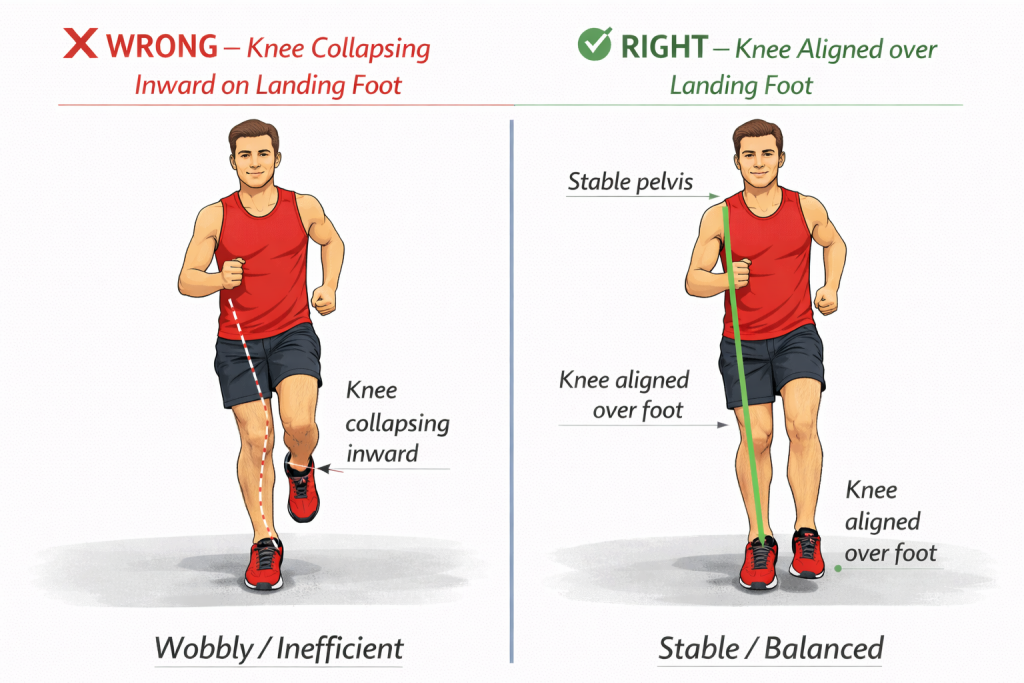
✅ What RIGHT Looks Like
- – Stable pelvis during stance
- – Knees tracking forward
- – Controlled hip movement
- – Efficient step width (not crossing midline)
- – Arms supporting balance
The runner appears:
- – Stable
- – Balanced
- – Efficient
❌ What WRONG Looks Like
- – Knee collapsing inward
- – Excessive pelvic drop
- – Feet crossing the midline
- – Excessive side-to-side motion
- – Arms swinging across the body
This often looks:
- – Wobbly
- – Inefficient
- – Unstable, especially under fatigue
Why This Happens
Often due to:
- – Weak hip stabilizers
- – Limited single-leg strength
- – Poor trunk control
- – Fatigue
Fix Now
- – Think “Strong hips”
- – “Run on two rails”
- – Keep arms relaxed
- – Slow down if form collapses
Work On (Long-Term)
- – Single-leg strength training
- – Glute med and hip abductor strength
- – Trunk stability under movement
BIG 3/5 — Landing – Center of Mass & Step Placement
Key cues: “Land under you” · “Shorten the step” · “Quiet feet”
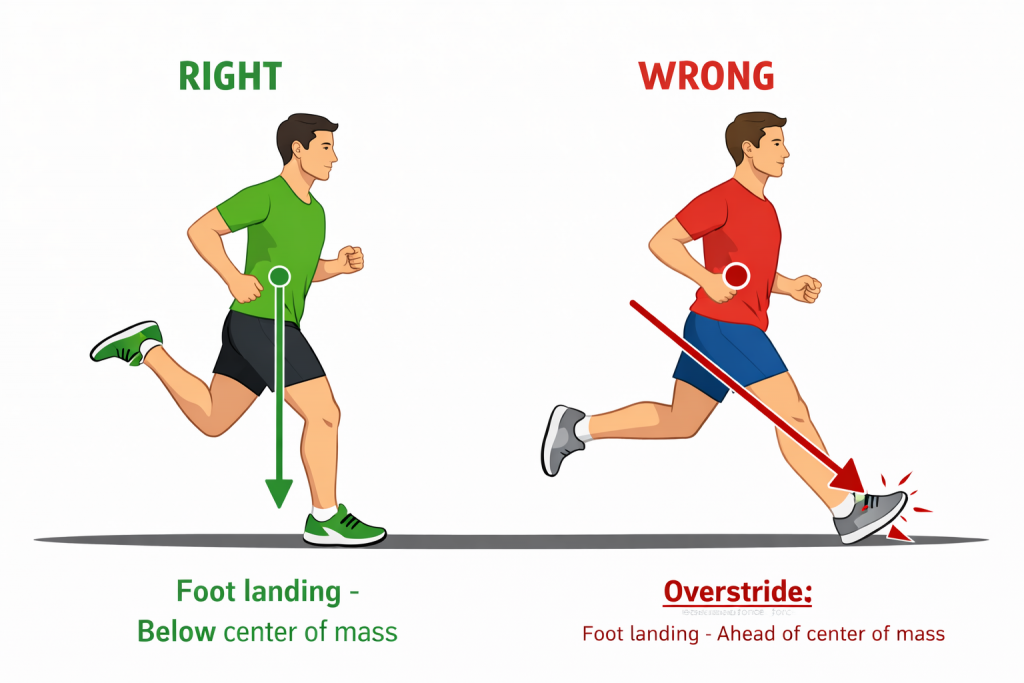
✅ What RIGHT Looks Like
- – Foot landing under or slightly in front of the center of mass
- – Short, quick steps
- – Minimal braking
- – Smooth forward movement
The runner looks:
- – Light
- – Efficient
- – Continuous
❌ What WRONG Looks Like
- – Overstriding
- – Long ground contact
- – Visible braking
- – Heavy foot strikes
Running often feels:
- – Heavy
- – Forced
- – More demanding than necessary
Why This Happens
Often related to:
- – Limited hip extension
- – Poor posture
- – Insufficient strength
Fix Now
- – Shorten the step
- – Slightly increase cadence
- – Focus on quiet contact
Work On (Long-Term)
- – Posture (BIG 1)
- – Alignment (BIG 2)
- – Posterior-chain strength (glutes, hamstrings, spinal extensors)
- – Hip mobility
BIG 4/5 — Foot Strike
Key principle: Foot strike is usually a result — not a goal.
In the BIG 5 framework, foot strike reflects what is happening upstream in your technique.
When posture, alignment, and step placement (BIG 1–3) work well, foot strike tends to organize itself naturally.
Trying to “fix” foot strike in isolation often creates new problems instead of solving the real one.
✅ What RIGHT Looks Like
- – Stable, controlled ground contact
- – Smooth transition through stance
- – Relaxed lower leg and foot
- – Adaptable to speed and terrain
At moderate speeds, many runners naturally show:
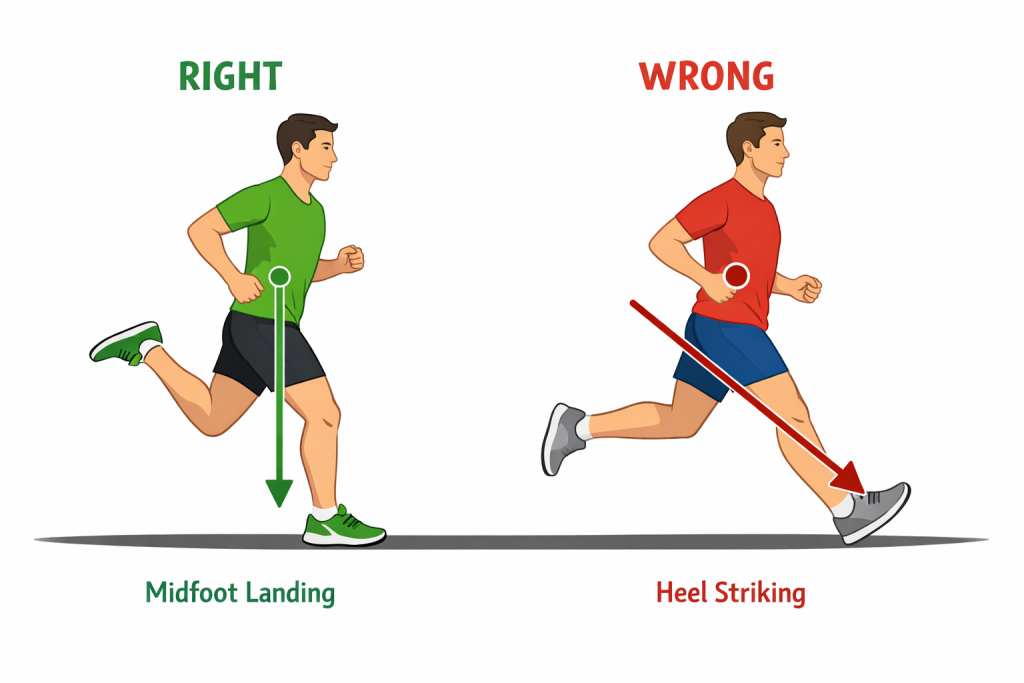
- – A midfoot contact
- – Or a light heel-first contact
When foot strike is working well, the runner looks:
- – Stable
- – Grounded
- – Efficient through stance
❌ What WRONG Looks Like
Overemphasized Heel Strike (Often Caused by Overstriding)
This is typically not “just a heel strike problem” — it is usually caused by the foot landing too far in front of the body.
What you see:
- – Foot clearly ahead of the center of mass
- – Visible braking at ground contact
- – Longer ground contact time
- – Stiffer, louder landing
Problems it can cause:
- – Increased braking forces
- – Higher loading at the knee
- – Reduced elastic energy return
- – Lower running economy
- – Higher risk of knee-related discomfort (especially at higher speeds)
Important:
A light heel contact under the body is rarely a problem.
A braking heel strike far in front of the body is the issue.
The real fix is usually BIG 3 (step placement), not “avoid heel striking.”
Forced Forefoot Strike (Running on the Toes)
This often happens when runners receive oversimplified advice like:
“You must run on your forefoot.”
What you see:
- – Running high on the toes
- – Excess plantarflexion (heel rarely touches ground)
- – Stiff ankle
- – Excess calf tension
Problems it can cause:
- – Calf overload
- – Achilles tendon stress
- – Increased foot intrinsic strain
- – Reduced stability at contact
- – Poor push-off mechanics (because the system is already tense)
- – Early fatigue in longer runs
In many cases, forcing a forefoot strike shifts load from the knee to the calf–Achilles complex — without improving overall efficiency.
Why Foot Strike Problems Happen
Foot strike issues are especially common in runners who:
- – Try to fix visible symptoms instead of root causes
- – Skip work on posture and step placement
- – Lack the strength to support a forced change
- – Follow rigid, dogmatic technique advice
In most cases, the problem is not where the foot lands — but why it lands there.
Fix Now – Simple, Effective Cues
During easy runs:
- – Stop forcing foot strike
- – Shorten the step
- – Improve posture
- – Focus on quiet, controlled contact
- – Let the heel touch lightly and naturally if it wants to.
If tension increases when you try to change foot strike, that’s a clear sign you’re forcing the system.
Work On – Long-Term Improvements
To support a healthy and efficient foot strike over time:
- – Improve hip extension (BIG 1 & 3)
- – Build posterior-chain strength
- – Develop calf–Achilles strength progressively
- – Maintain ankle mobility
- – Reinforce good step placement
A good foot strike is built — not imposed.
BIG 5/5 — Rhythm & Active Ground Contact
Key cues: “Light and quick” · “Relax to move fast”
✅ What RIGHT Looks Like
- – Active, responsive contact
- – Relaxed push-off
- – Clear, repeatable rhythm
- – Minimal unnecessary tension
The runner looks:
- – Elastic
- – Effortless
❌ What WRONG Looks Like
- – Excess muscular tension
- – Forced push-off
- – Heavy appearance
Running feels:
- – Hard
- – Rigid
- – Unsustainable
Fix Now
- – Relax shoulders, hands, jaw
- – Slightly quicken rhythm
- – Add short relaxed strides
Work On (Long-Term)
- – Gradual strength development
- – Technique blocks
- – Practice relaxation at easy pace
If You Remember Only One Thing
Fix BIG 1–3 first.
Most runners do not need more effort — they need better structure.
Two Simple Self-Check Metrics
1) Cadence
General guideline for speeds between 8–20 km/h: ~160–190 steps per minute.
2) Vertical Oscillation
Typical flat values: ~6–11 cm.
Use these as guidance, not rigid rules.
How We Work With Running Technique at Arduua
At Arduua, running technique is never treated as an isolated skill.
We see it as part of a bigger system that includes strength, mobility, training load, and the runner’s background.
That’s why the BIG 5 assessment is always the starting point — but for more advanced runners, we of course analyze additional aspects as well.
Our coaching philosophy
- Technique coaching must be individualized.
- What’s right for one runner can be wrong for another.
- Fix what limits efficiency and durability first
We prioritize posture, alignment, and step placement before chasing details. - Test → Adjust → Retest
Improvements are always validated by how running feels and performs. - Short-term cues + long-term development
Quick fixes help immediately, but strength and mobility create lasting change.
Ways We Can Help You Improve Your Running Technique
1. Personal Online Coaching
All our coaching includes a structured onboarding where running technique is assessed together with the full athlete profile.
Upstart assessment includes:
- – Basic running technique assessment
- – Mobility & strength screening
- – Running tests
- – Comprehensive questionnaire
👉 https://arduua.com/trail-running-coach-online/
Online Running Biomechanics Analysis
For runners who want a deeper biomechanical breakdown:
Led by David Garcia – Running Biomechanics Expert
👉 https://arduua.com/product/online-running-biomechanics-analysis/
Continue Learning: Upcoming Arduua Webinars
The Running Technique – BIG 5 (Fundamentals) webinar is part of Arduua’s ongoing education series, designed to help runners build a strong, durable foundation step by step.
If you enjoyed this session, here’s what’s coming next:
Mobility & Strength Assessment – Fundamentals for Runners
Thursday, 12 March | 19:00–20:00 (CET)
Host: Marija Kostic
Language: English
Learn how to assess the most important mobility and strength factors for runners, what “good enough” mobility really means, and how limitations can affect technique, performance, and injury risk.
Includes video examples and practical explanations.
Yearly Plan & Periodization – Build Your Season the Smart Way
Thursday, 16 April | 19:00–20:00 (CET)
Host: David Garcia
Language: English
Understand how to structure a yearly training plan, work with training phases, and plan A/B/C races to peak at the right time — without guessing.
Optimizing Training Load & Recovery
Thursday, 14 May | 19:00–20:00 (CET)
Host: David Garcia
Language: English
Learn how to balance training stress and recovery, avoid overtraining or undertraining, and make smarter day-to-day training decisions using practical principles.
Participation & Booking
- Included for all Arduua Online Coaching and Membership Plan customers.
- First webinar is free for all runners.
- All webinars are held online and in English or Spanish.
📩 Booking & questions: katinka.nyberg@arduua.com
A blog by Katinka Nyberg, Founder of Arduua, created with special guidance from David Garcia, Head Coach at Arduua.